
Resistance bands covers three different tools: loop bands, tube bands and power bands. Mixing them up is the most common reason people end up with a band that doesn’t suit what they wanted it for. Here’s how they differ, what each one is for, and a short workout for each type.

Loop bands
Loop bands are short, continuous loops of latex or fabric, usually 30 to 60cm around. People use them mainly for lower-body activation and mobility: glute bridges, lateral walks, clamshells, and warm-ups before squats or deadlifts.
- Good for glute and hip activation, warm-ups, physio and rehab exercises, and mobility work.
- Latex or fabric: latex loops like the Liveup Mini Resistance Loop Bands x 3 are stretchier and cheaper. Fabric loops like the Premium Fabric Loop Band Set of 5 or the Hip Bands set of 3 LivePro grip your skin and don’t roll or slide up the thigh during lateral walks. Rolling is the most common complaint about cheap latex loops.
- Resistance: loops usually come in graded sets from light to extra heavy, so you can match the band to the exercise, lighter for activation and heavier for banded squats.
If loop bands have rolled up or snapped on you before, fabric usually fixes it for a small extra cost. See the full range in mini loop bands and booty bands.
Starter loop band workout
Put a light or medium loop around your thighs just above the knees. Do 2 to 3 rounds, resting a minute between rounds.
- Glute bridge: 15 reps
- Clamshell: 12 reps each side
- Lateral band walk: 10 steps each way
- Banded squat: 12 reps
- Standing kickback with the band around your ankles: 12 reps each leg
Tube bands with handles
Tube bands are round, hollow tubing with handles or ankle straps at each end, sometimes with a door anchor. They’re the closest band equivalent to a cable machine, because you can pull, press, row and curl in more directions than a loop band allows.
- Good for upper-body strength work like rows, presses and curls, and anywhere you’d rather hold a handle than loop a band around a limb. They also travel well, since a full upper-body session fits in a small bag.
- Check the tubing where it joins the handle, because that’s where tube bands most often fail. The Toning Tube with Handles Light, Medium and Heavy are 120cm long with 7.5kg, 10kg and 15kg of tension. For a heavier band, look at the LivePro Heavy Duty Resistance Rubber Band With Handles.
- Door anchors: if you train at home without a rack, a door anchor like the Resistance Band Door Anchor Sponge LivePro turns tube bands into a stand-in for many cable exercises, so check whether your set includes one.
There are more in resistance bands with handles.
Starter tube band workout
Anchor the band in a door at chest height and do 2 to 3 rounds:
- Standing row: 12 reps
- Chest press, facing away from the door: 12 reps
- Bicep curl, standing on the band: 12 reps
- Overhead press, standing on the band: 10 reps
- Face pull with the anchor at head height: 12 reps
Power bands
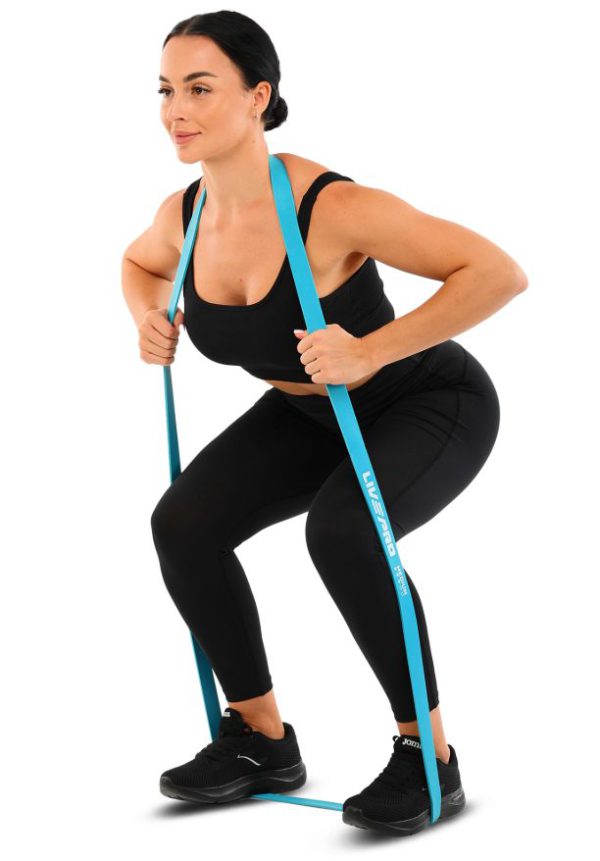
Power bands are the long, flat, heavy loops you’ll see wrapped around a pull-up bar for assisted pull-ups, or used for banded squats, accommodating resistance on deadlifts and mobility stretching. Ours are 2m loops (2080mm around), far stronger than loop bands, and they’re sold by width instead of a light, medium or heavy label.
- Good for assisted pull-ups and dips, accommodating resistance on barbell lifts, mobility and stretching, and strength training once you’ve outgrown loop bands.
- Width sets the resistance. The wider the band, the more it resists, and power bands are typically sold from about 13mm up to 45mm or more. Ours start at the Power Band 2meters x 6mm for light rehab work. A set like the Hiperlion Power Band Full Set or the 3 x Power Band Set Livepro gives you several widths at once. That helps because band-assisted work like pull-ups needs a lighter band as you get stronger.
- If you know roughly what resistance you need, a single band like the SKLZ Fitness Pro Band Heavy / Grey will do.
See the full range in power bands and pull up bands.
Exercise bands for pull-ups
A power band takes some of your bodyweight at the bottom of a pull-up, where it’s hardest. To set one up, loop the band over the bar, pull one end through the other and tighten it. Then put a foot or knee in the bottom of the loop and hang with straight arms before you pull.
- Which width: thicker bands give more help. The LivePro resistance chart puts the 12mm X-Light at 7 to 12kg, the 21mm Light at 22 to 35kg and the 32mm Medium at 45 to 55kg.
- Where to start: choose a band that lets you do 5 to 8 clean reps.
- How to progress: when 3 sets of 8 feel easy, move to a thinner band. Having several widths saves buying replacements, and the Power Band Set of 5 + Door Anchor covers five resistance levels.
Starter power band workout
- Band-assisted pull-up: 3 sets of 5 to 8
- Band pull-apart: 3 sets of 15
- Banded good morning: 3 sets of 12
- Banded push-up, band across your upper back: 3 sets of 8 to 10
- Overhead shoulder stretch holding the band: 2 holds of 30 seconds
Which one should you buy?
- Glute and hip activation and warm-ups: loop bands, fabric if the budget stretches.
- Upper-body strength, rows, presses and training on the road: tube bands with handles.
- Assisted pull-ups, barbell accommodating resistance and mobility work: power bands, preferably a graded set.
- Not sure yet, or want one band for a bit of everything: a mid-weight power band covers stretching, assistance and general resistance work.
Resistance levels and progression
Whichever type you choose, one band at one resistance is usually a mistake. Exercises need different resistance (a band that’s right for lateral walks is too light for a banded squat), and you’ll want more as you get stronger. Graded sets, sold as light, medium and heavy or by colour, cost a bit more upfront but save you replacing a single band every few months once it stops being a challenge.
Care and durability
Bands are rubber or latex under tension, so sun, extreme temperatures and talc or chalk residue all shorten their life. Store them out of direct sun, wipe them down after use if you chalk up, and check for small nicks or thin spots before each session. That’s where bands usually snap.
Bands compared
| Band | Type | Size | Resistance | Price |
|---|---|---|---|---|
| Mini Resistance Loop Band ‘Medium’ | Latex loop | 500mm x 50mm, 0.60mm thick | Medium | $9.00 |
| Mini Resistance Loop Band ‘Heavy’ | Latex loop | 500mm x 50mm, 0.80mm thick | Heavy | $9.00 |
| Liveup Mini Resistance Loop Bands x 3 | Latex loop set | 500mm x 50mm | Light, medium and heavy | $19.95 |
| Hiperlion Loop Band Xtra Heavy | Latex-free loop | 600mm loop, 1.2mm thick | Xtra heavy | $12.00 |
| Hip Bands set of 3 LivePro | Fabric hip bands | Three lengths | Set by length | $59.00 |
| LivePro Power Loop Set of 3 | Fabric loops | Smaller than a power band | Three levels | $49.00 |
| Toning Tube with Handles Light | Tube with handles | 120cm | 7.5kg | $19.00 |
| Toning Tube with Handles Medium | Tube with handles | 120cm | 10kg | $19.00 |
| Toning Tube with Handles Heavy | Tube with handles | 120cm | 15kg | $19.00 |
| Power Band 2meters x 6mm | Power band | 2080mm x 6mm | Light rehab | $15.00 |
| Power Band 2m x 12mm X-Light | Power band | 2080mm x 12mm | 7 to 12kg | $19.00 |
| Power Band 2m x 21mm Light | Power band | 2080mm x 21mm | 22 to 35kg | $29.00 |
| Power Band 2m x 32mm Medium | Power band | 2080mm x 32mm | 45 to 55kg | $39.00 |
| 3 x Power Band Set Livepro | Power band set | Three bands | Three levels | $59.00 |
| Power Band Set of 5 + Door Anchor | Power band set | Five bands and a door anchor | Five levels | $149.00 |
Browse all our resistance bands. We ship NZ-wide.